

Having a unique voice has become essential for successful brands in 2023. Whether you’re talking to customers on social media, creating signs and menus, or designing an online storefront, having a well-thought out brand voice will help keep all of your communication efforts consistent with your business goals. Keep in mind that a brand voice is not the same thing as brand identity, which encompasses color, shapes and other visual elements in addition to voice. While it does play a role in design as well, brand voice primarily focuses on how you and your staff can channel the brand’s values and mission through everyday interactions. There are many ways to figure it out, but here – tested, tweaked, and perfected over the past five years – I’ve outlined in detail my favorite process for finding a new brand voice. Enjoy!
Finding the right tone
With a well-rounded brand voice, your audience should be able to get a sense of your company values through social media replies, emails, in-person conversations, and more. Okay, so, say you own a food truck that focuses on local ingredients. Your company values may include “seasonal ingredients”, “fresh, handmade food” and “welcoming to everyone”. What descriptive words come to mind when you read your brand values? List them all! Typically it’s good to write out as many words as possible, but here is a shortened example:
- “Seasonal ingredients”
- fresh
- new
- healthy
- local
- flavorful
- “Fresh, handmade food”
- thoughtful
- creative
- relatable
- delicious
- comforting
- “Welcoming to everyone”
- kind
- inclusive
- happy
- optimistic
- diverse
- accessible
and so on. Next, pick out the words that are informative, or describe the business, along with the words that are more emotive, or describe how the business makes you feel. These words can be organized into two categories: informational voice and conversational voice. Our example would look like this:
- Informational voice:
- flavorful
- creative
- kind
- Conversational voice:
- healthy
- comforting
- happy
You may end up with a bunch of words for either category, or just a couple. That’s okay! Every personality is different, some more complicated than others. These words just give you an idea of how to set your tone in difference scenarios. So in this example, describing our theoretical food truck’s menu and business practices may give customers an impression of flavorful, creative dishes served by kind people. Taking an order over the phone or through an online platform should leave customers feeling happy, comforted, and like they made a healthy choice.
This could mean that you use a lot of adjectives to describe your food – like crunchy, savory, fresh-picked, etc. It could also mean that you prioritize active listening in your conversations, shown in how you might repeat an order back to a customer or include inclusive language in a email newsletter. By simply understanding how you wish to present yourself and what impression you’re trying to make, you immediately have more control over your brand voice.
However, these efforts can get lost over time, especially when there are multiple staff members or the business goes through a change in leadership. To create a strong, long-lasting brand voice, you need to make a reference chart.
Creating a brand voice chart
I like to create my brand charts in a digital spreadsheet, but you could easily tweak this to your needs, or simply start with a piece of scrap paper to organize your thoughts and tailor it to your needs from there.
Create four columns: Impression, Description, Dos, and Don’ts. Each row will contain one of your descriptive words (Impression), a sentence or list to give context for the impression (Description), an example of how to use the impression (Dos), and an example of how not to use the impression (Don’ts). Our food truck example would look something like this:
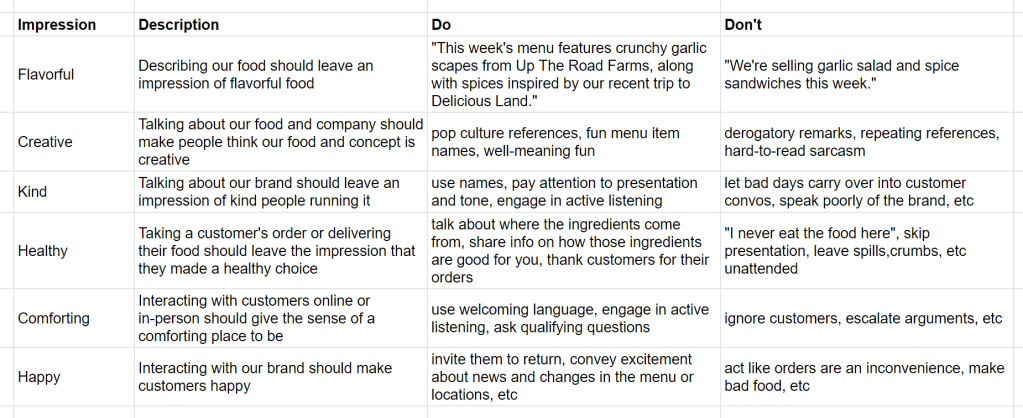
Your chart will probably look a little different from mine. Adding a ‘scenarios’ column could help you refine your voice even further if necessary. Some people like to assign different impressions/traits to specific scenarios, such as using ‘comforting’ primarily for online customer service interactions, or ‘flavorful’ only when talking about the menu. Personally, I find it easier to adjust how I use the brand voice to individual conversations or use-cases, but it really does come down to personal preference.
This step is essential to creating a well-rounded, cohesive voice that can be taught and replicated by anyone representing the brand. It can be handed over to content writers (hi, it’s me) as a quick reference for writing blog posts for the brand, or used in training sessions for customer-facing roles.
Using your brand voice (not bland voice)
Aside from understanding your mission statement and values, having a cohesive brand voice is essential for truly connecting with your audience. So many creators and new businesses are afraid to inject personality into their day-to-day conversations, making it more challenging to leave a lasting impression. Jazz it up! Lean into your voice traits when writing newsletters and coming up with new signage. Keep those descriptive words in the back of your head when creating retail displays and crafting menus. Most importantly, fall back on the brand’s most human-like qualities when having difficult conversations. Putting that conversational framework in place makes it much easier to get out of sticky situations (or at least keep them from escalating), especially if you aren’t sure where to begin.
Do you have a brand voice chart, or is this new to you? I’ve relied on this process for several years and it never steers me wrong. Tell me about your brand voice journey, or reach out with any questions through the contact page. I’d love to hear from you!
 Jen Coe | Artist & Instructor